Monthly Archives: October 2016

The Importance of Analogy (or, how to avoid dualism and make learning possible)–Part 4

So, we’ll need to review a bit, and then let’s talk about God.

Univocal predication is impossible between God and creatures….Thus also this term “wise” applied to man in some degree circumscribes and comprehends the thing signified; whereas this is not the case when it is applied to God; but it leaves the thing signified as incomprehended, and as exceeding the signification of the name. Hence it is evident that this term “wise” is not applied in the same way to God and to man. The same rule applies to other terms. Hence no name is predicated univocally of God and of creatures.

Neither, on the other hand, are names applied to God and creatures in a purely equivocal sense, as some have said. Because if that were so, it follows that from creatures nothing could be known or demonstrated about God at all; for the reasoning would always be exposed to the fallacy of equivocation. Such a view is against the philosophers, who proved many things about God, and also against what the Apostle says: “The invisible things of God are clearly seen being understood by the things that are made” (Romans 1:20). Therefore it must be said that these names are said of God and creatures in an analogous sense, i.e. according to proportion.

(source: Summa Theologica I.13.5 respondeo)

Now, if this were a slightly different sort of philosophical journey, I might say, “And Zhaozhou achieved satori.”

But back in the real world….

Benozzo_Gozzoli_004a-1.jpg

This sounds difficult, I grant.  But remember what we’ve already seen:

  • When the child learns the word “Bug!” for a beetle, and applies it to insects, raisins, and the dog (but not the VW Beetle), the child is using language “analogously,” and will learn by specification which analogies are fit and which are not;
  • When the child learns to use “bug” for a range of insects, and to exclude butterflies and spiders, the child begins to use “bug” univocally;
  • When big sister teases the child by saying “Look out! there’s a bug in front of you!” when they stand in front of a VW Beetle, the child is confused because big sister has used “bug” equivocally.

In other words, we speak in analogies when we are learning; we discover the proper scope of terms, the fitness of certain common understandings across various applications in various contexts.  In the sense that our learning never ceases to be informed by how we learn it, that every body of knowledge (or clump of understanding, or field, or discipline, or science, or art) has its own coherence and purpose, its own “formal principle” derived from some more comprehensive and fundamental understanding, our learning and conversation are therefore always fundamentally analogous and only univocal or equivocal by specialization, derivation, or corruption (especially in the case of deluding equivocations).

We can speak univocally when and to the extent that we share a scope, context, and purpose with another, provided of course that the object of our discussion actually fits that scope, context, and purpose.  Any conversation about that fitness, however, would have to be conducted by analogy.

And here is the terribly important point:  disregarding the fundamental role of analogy and insisting on univocal discourse generally leads us to equivocate, and we either end up pushing opposing “not…but…” statements whose opposition is founded in an equivocation; or we end up agreeing on apparently univocal utterances that are founded on an invisible equivocation that we all assume without examination.  [Here read the brief excursus on modern and postmodern, if you like.]

So every understanding–every set of observations and claims, everything we are able to make some definite and univocal statements about–is bounded by certain judgments of fitness.  We can speak univocally about how one tree relates to another; we have learned what in each tree is analogous to every other tree, and are competent to make judgments of fitness about “how different is too different”–judgments we make by analogy, and which become definitions.  These definitions form the boundaries of sets of univocal claims, or particular “sciences.”  Because we are always, to some extent, learning, these judgments are always potentially reformable; yet each set of understandings contains some elements which must be true, or nothing else about them makes sense–and each contains some definite judgments without which that set of understandings fails to cohere.  The latter are called “formal principles,” and the former can have several names, depending on the kinds and sources of knowledge fitting to that science.  These include “intuitions,” “axioms,” “dogmas,” and the like.

Which brings us, at last, to the knowledge of God.

Like any other kind of learning, the learning that is involved in growing to understand God, getting to know Him well enough to become His friend, necessarily happens by analogy.  But with the knowledge of God, three related things happen to make it necessary to say that we can only speak of God by analogy.

First, and simplest, we are never going to have exhausted the knowledge of God.  True, if St. Thomas is right, there will come a time when we fully understand God’s relationships to all things–this is one way of describing the Beatific Vision, the ability to behold God as He really is, that is, to look upon God’s essence.  Yet St. Thomas also points out that even in this gazing upon God as He really is, we will not exhaustively comprehend God; there will always be more to His self-understanding than even our wholly perfected understanding can possibly keep in mind.  Therefore, even when we have the fullest possible capacity to make univocal statements about our knowledge of God, that knowledge itself will remain analogical in nature; those claims will be perfectly true claims about what can be known of God, but will always imply “and more” in a way that requires us to reason differently about those than we might about the cultivation of fruit trees.

Second, and only slightly more complex, the knowledge of God necessarily articulates with all our other understandings by analogy.  Remember that we discussed how each science, each set of understandings that we are able to state as univocal claims within a certain scope, context, and purpose, is necessarily bounded by judgments of the “fitness” that relate the scope, context, and purpose to the objects considered–that each body of knowledge is itself founded and bounded by analogy to other sciences, specifically to sciences that cover a broader scope at a higher level of explanation.

If there is any God, though, then God must be the Creator; the Creator’s intention and action must be the broadest scope, the inescapable context, the final purpose of every other object of our knowledge; and therefore the science of knowing God, that is, the set of univocal claims that we can make about what we can know of God’s intention, and action, must always stand in the relation of an analogy to every other kind of knowledge we have.

The only thing that could possibly found and bound such a set of claims would be knowledge of God; and having already used up all the other ways of knowing, we must acknowledge that here we enter upon a species of knowing which is both direct revelation and defined knowledge.  The sources of that definite knowledge, data of Creation and Redemption history, include the very words given to the prophets and apostles, the specific words of Christ, and what we have successfully learned from these in ways God has given humans the ability and authority to define.  The direct revelation stands behind these, and draws them forth, and also works in each of us who by God’s grace receive the infused theological virtue of faith, and continue in the obedience of faith, being drawn into friendship with God; this direct revelation is utterly inseparable from the definite knowledge, for only when they are conjoined do they provide us with a proper analogy–the analogy of Being upon which the analogy of Faith is built, and to which it refers.

Our claims about God can only be stated by analogy because it is knowledge of God that provides the analogies by which all learning, and therefore all systems of univocal claims, are possible.  Explicitly or tacitly, to understand God’s intentions and actions, to be drawn into friendship with Him, provides the scope, context, and purpose for all possible knowledge.  As the apex of all knowing, it is therefore pure analogy, insusceptible of reduction to univocal claims; all univocal claims about what we know of God cohere only under this analogy, as do all possible claims of any form about any other knowledge.

Jacob_The-Brain

Third, and most complex, though hinted by the other two, our very condition as creatures who think in created brains and whose understanding is ordered to friendship with God requires that analogy, not univocal speech, be the apex of our knowledge of God, hence of all things.  As creatures, our understanding is built up according to rules encoded in Creation (like physical laws, changeability over time), in our metaphysically human being (our ability to conceive what our body cannot directly perceive or do, our capacity to intentionally reform our habits based on intentions conceived in the mind), or in our physical human being (like the relationship between brain structure and the nature of imagination, the variability of human senses, the pleasure/pain principle in our appetites and arousals, or our capacity for learning and repeating vocables).

Whatever capacity to understand God’s intentions and actions we have must, therefore, be a feature of our existence as human creatures who are physically and metaphysically continuous with the whole of Creation; the capacity of the Creation to participate in the life of the Creator is itself a manifestation of those intentions and actions which we are made to understand.  We cannot repudiate our creaturely being, in order to choose another; we cannot have a way of knowing that is unrelated to our manner of learning.  It is therefore impossible to think that our knowledge could be greater than our kind of being is capable of, though it is indeed possible that our capability in a graciously improved and in a perfected state is much greater than we naturally seem capable of.

The kind of knowledge we can have of God is, necessarily, the kind possible within the mind–let us focus on the brain itself, when we say that, though the principle holds for whatever is metaphysically “beyond the brain” about our knowing, too.  But this kind of knowledge must, itself, be an unfolding of the Creator’s intention that we come to know Him in an act of creating us such that we can know Him and actually continuing our existence as creatures who come to know Him (and intervening, too, but that is a separate matter for us, at a different level of explanation).  In other words, my being a human creature knowing God’s intentions and actions is, itself, a manifestation of those intentions and actions; my knowledge of those intentions and actions must necessarily stand in a relation of analogy, rather than a relation of univocal reduction, if that knowledge is to be thought possible.

Indeed, my understanding God can never be only my successful reduction of divine revelation to definitions, nor can it be an attempt to experience divine revelation as undefined:  Scylla gains me a univocal system but steal from me the necessary warrants for my belief, without which it will harden into despair and provoke unbelief in others; Charybdis gains me a moment’s freedom from the reductive habit, but steals from me the capacity to believe what I have learned, without which it will harden into unbelief and provoke despair in others.

My understanding God is always a divine revelation that what knowledge of God I have definitely gained is, itself, a manifestation of God’s intention and action in creating me; that I may “love God with my mind” as indeed with every other part of my creaturely being.

Anything less, in the end, is one kind or another of dualism, some kind of despairing of or striving after gnosis.

I hope, in a future post, to discuss the application of analogy to specific kinds of understanding God, and to language theory and allegory and poesis, the topics which engage my attention most fully.  But for now, we’ll mark this one concluded, and I hope somebody will ask good questions and provide sound criticisms to help me improve my understanding.

Because that would be a work of mercy, and an act of friendship, and a sign of the love of God being poured out in your heart.  Many thanks.

Further Interlude, still on Analogy, from the Ox

Just in case you did not, in fact, read it all:

Univocal predication is impossible between God and creatures. The reason of this is that every effect which is not an adequate result of the power of the efficient cause, receives the similitude of the agent not in its full degree, but in a measure that falls short, so that what is divided and multiplied in the effects resides in the agent simply, and in the same manner; as for example the sun by exercise of its one power produces manifold and various forms in all inferior things. In the same way, as said in the preceding article, all perfections existing in creatures divided and multiplied, pre-exist in God unitedly. Thus when any term expressing perfection is applied to a creature, it signifies that perfection distinct in idea from other perfections; as, for instance, by the term “wise” applied to man, we signify some perfection distinct from a man’s essence, and distinct from his power and existence, and from all similar things; whereas when we apply to it God, we do not mean to signify anything distinct from His essence, or power, or existence. Thus also this term “wise” applied to man in some degree circumscribes and comprehends the thing signified; whereas this is not the case when it is applied to God; but it leaves the thing signified as incomprehended, and as exceeding the signification of the name. Hence it is evident that this term “wise” is not applied in the same way to God and to man. The same rule applies to other terms. Hence no name is predicated univocally of God and of creatures.

Neither, on the other hand, are names applied to God and creatures in a purely equivocal sense, as some have said. Because if that were so, it follows that from creatures nothing could be known or demonstrated about God at all; for the reasoning would always be exposed to the fallacy of equivocation. Such a view is against the philosophers, who proved many things about God, and also against what the Apostle says: “The invisible things of God are clearly seen being understood by the things that are made” (Romans 1:20). Therefore it must be said that these names are said of God and creatures in an analogous sense, i.e. according to proportion.

Now names are thus used in two ways: either according as many things are proportionate to one, thus for example “healthy” predicated of medicine and urine in relation and in proportion to health of a body, of which the former is the sign and the latter the cause: or according as one thing is proportionate to another, thus “healthy” is said of medicine and animal, since medicine is the cause of health in the animal body. And in this way some things are said of God and creatures analogically, and not in a purely equivocal nor in a purely univocal sense. For we can name God only from creatures (Article 1). Thus whatever is said of God and creatures, is said according to the relation of a creature to God as its principle and cause, wherein all perfections of things pre-exist excellently. Now this mode of community of idea is a mean between pure equivocation and simple univocation. For in analogies the idea is not, as it is in univocals, one and the same, yet it is not totally diverse as in equivocals; but a term which is thus used in a multiple sense signifies various proportions to some one thing; thus “healthy” applied to urine signifies the sign of animal health, and applied to medicine signifies the cause of the same health.

(source: Summa Theologica I.13.5 respondeo)

Whose Kingdom Is This, Anyway?

So every once in a while I have to grit my teeth through some inappropriate mixture of nationalist sentiment with Christian worship or teaching.  We all know that “patriotism,” love of one’s home place and relations and culture, one’s “homeland” and its people, is a basic good.  And “patriotism” can be expressed a variety of ways:  the loyal soldier in a just war is one kind of patriot, as is the family who waits and prays and works to heal the society wounded by war, as are those who work hard to make justice and peace prevail among the people.  There are also “patriots” who risk their lives and fortunes, pledging their honor for the justice of their cause, to change wicked regimes for better ones.  There are “patriots” who counsel their nation wisely, and provide just laws; there are “patriots” who plead with their people to leave behind wicked customs and laws.  Jeremiah was a patriot, and God had to specifically instruct him not even to pray for the good of his people–and Jeremiah was hated by his rulers, and kidnapped by those who loved him but did not understand God’s message.

So when we sing hymns to one of the nations of this world in a service that ought to be wholly concerned with the communion of the People of God with their God, united in all times and places to the Sacrifice of Christ, bringing with them all of their humanity and nothing that will not endure in the Kingdom, I am pretty much appalled.  I can understand some songs that are prayers to God on behalf of those who serve–the Anglican hymn “Eternal Father, Strong to Save” is perhaps the best of the breed, and if I really strive to interpret it carefully “America, the Beautiful” is not the worst (though it still addresses the nation, rather than God).  But other songs, which manifestly divert our attention from God to nation, have no place whatsoever in Christian worship–here I think of “My Country, ‘Tis of Thee,” a song which I would love were I not so frustrated by its perversion of worship.

And I do not say that one should not, in whatever measure the regime can merit, have separate civic songs and ceremonies.  I can no longer pledge allegiance to the United States of America with a clean conscience, but I could for much of my life, and did; I can’t really sing “The Star-Spangled Banner” these days without revulsion, but I learned five verses of it in Kindergarten and can still sing all of them by heart.  I can still sing more verses of “The Battle Hymn of the Republic” than, I’ll warrant, most of you have ever learned.  But I cannot ignore the appalling heresy that song preaches so vigorously, anymore.

And so when there is an actual meeting of worship or teaching that is definitely under the auspices of the Church and designed to integrate us all more deeply into the Body of Christ, I am utterly convinced that there ought not be nationalist hymns or flags or other marks of devotion to a regime.  Certainly, we ought to pray for those in authority, and certainly the Church is herself a real earthly power as well as the beachhead and embassy of an heavenly Kingdom, but any relationship to the nation we entertain within the service of worship or the catechetical session ought to be strictly a matter of diplomacy with a foreign power.  And like any diplomacy, it ought to be measured; sublimated to our real interests; and subject to our observations of whether that power is friendly, neutral, hostile, or at war with us.

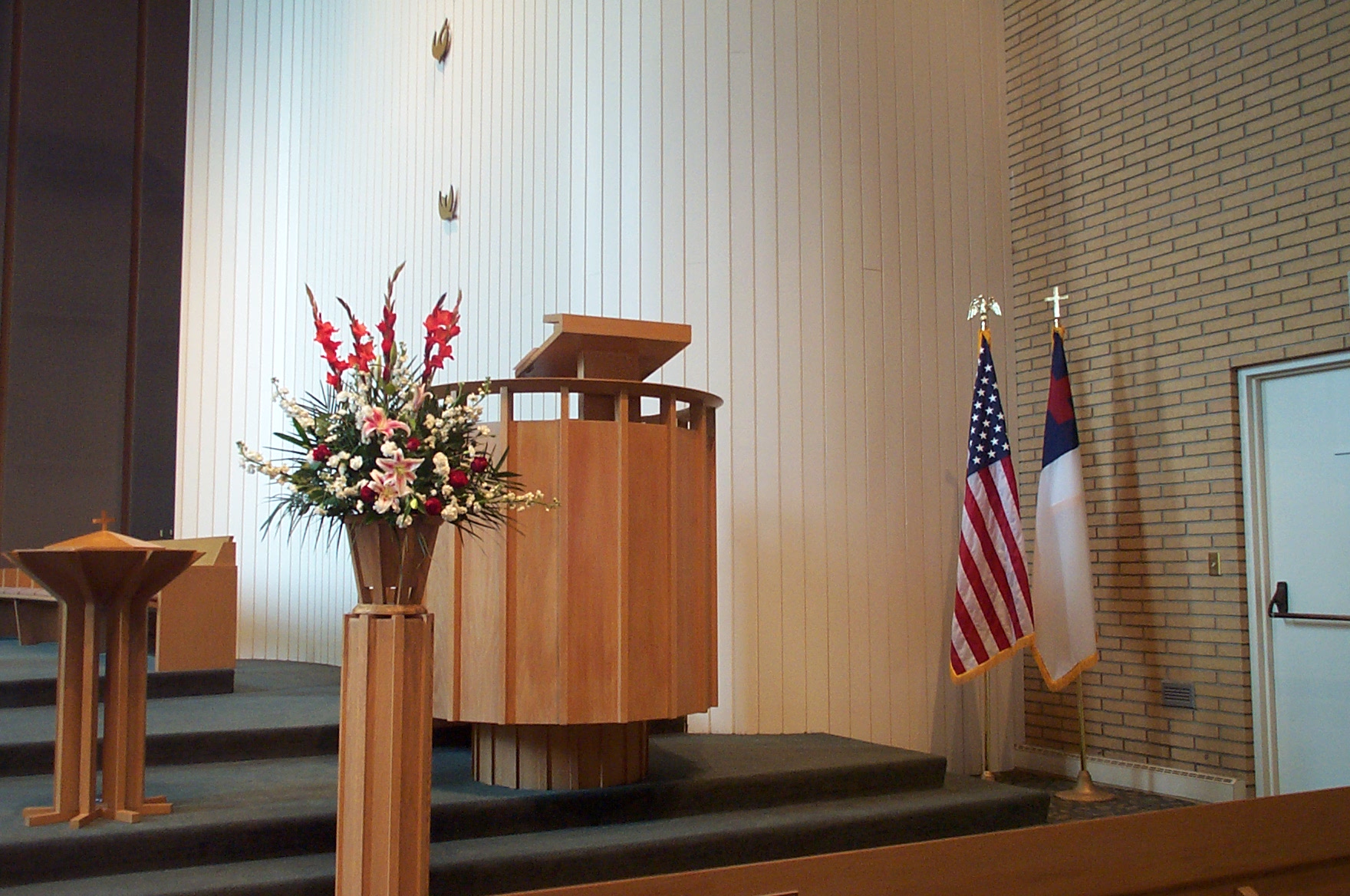
I ask you, then, whether you would not find yourself thinking of the church service as “their service” rather than “our service,” if there were prominent displays of devotion to this flag?

Or, perhaps, to bring the matter home, if my parish were to prominently display this flag?  We have several wonderful friends from this nation in our parish, these days:

Flag_of_Cameroon.svg

There is certainly nothing wrong with loving home and hearth, kin and country, and even loving the King or Queen or Republic, if they are virtuous.  And not promoting devotion to these, when they are vicious, does not mean loving home and hearth, kin and folk and people and place, any less; and it does not necessarily mean being disobedient (unless and until the regime can be replaced with a more just one).  It just means making sure that when we enter the Kingdom of God, we make sure all other regimes are understood to be foreign; that we do not permit any culture to “capture” the communion of the saints in our time and place.

The use of Latin at Mass is an obvious way to help correct this.  The strict derogation of all nationalist symbols away from the sacred precinct is another.

So this is blatantly unacceptable, and should horrify any well-formed Christian (also, anybody with a modicum of decent taste):

dt-common-streams-streamserver

But even this, I would argue, is too strong a conflation of kingdoms:

Christian_Flag_etc_Covenant_Presbyterian_Long_Beach_20050213

(We can talk about the “Christian Flag,” which I pledged along with the American flag and the Bible at least six times a week through all my school years, until I realized the “Christian Flag” had no meaning whatsoever as a flag and quit pledging my allegiance to vague nothings, another day.)

So I very definitely and intentionally remove flags and other symbols of devotion to any regime from any space where Christian service or teaching will be held, in the same way as I prepare the space with Bible, crucifix, image of Our Lady, and other proper marks of the devotion that belongs to the People of God entering the Kingdom of God.

And I am convinced that you should do this, too.

Interlude, still on Analogy, from the Ox

Carefully read all of the Angelic Doctor’s words on the subject of the names of God before going on:

as regards absolute and affirmative names of God, as “good,” “wise,” and the like, various and many opinions have been given. For some have said that all such names, although they are applied to God affirmatively, nevertheless have been brought into use more to express some remotion from God, rather than to express anything that exists positively in Him. Hence they assert that when we say that God lives, we mean that God is not like an inanimate thing; and the same in like manner applies to other names; and this was taught by Rabbi Moses. Others say that these names applied to God signify His relationship towards creatures: thus in the words, “God is good,” we mean, God is the cause of goodness in things; and the same rule applies to other names.

Both of these opinions, however, seem to be untrue for three reasons.

First because in neither of them can a reason be assigned why some names more than others are applied to God. For He is assuredly the cause of bodies in the same way as He is the cause of good things; therefore if the words “God is good,” signified no more than, “God is the cause of good things,” it might in like manner be said that God is a body, inasmuch as He is the cause of bodies. So also to say that He is a body implies that He is not a mere potentiality, as is primary matter.

Secondly, because it would follow that all names applied to God would be said of Him by way of being taken in a secondary sense, as healthy is secondarily said of medicine, forasmuch as it signifies only the cause of the health in the animal which primarily is called healthy.

Thirdly, because this is against the intention of those who speak of God. For in saying that God lives, they assuredly mean more than to say the He is the cause of our life, or that He differs from inanimate bodies.

Therefore we must hold a different doctrine–viz. that these names signify the divine substance, and are predicated substantially of God, although they fall short of a full representation of Him. Which is proved thus. For these names express God, so far as our intellects know Him. Now since our intellect knows God from creatures, it knows Him as far as creatures represent Him. Now it is shown above (I:4:2) that God prepossesses in Himself all the perfections of creatures, being Himself simply and universally perfect. Hence every creature represents Him, and is like Him so far as it possesses some perfection; yet it represents Him not as something of the same species or genus, but as the excelling principle of whose form the effects fall short, although they derive some kind of likeness thereto, even as the forms of inferior bodies represent the power of the sun. This was explained above (I:4:3), in treating of the divine perfection. Therefore the aforesaid names signify the divine substance, but in an imperfect manner, even as creatures represent it imperfectly. So when we say, “God is good,” the meaning is not, “God is the cause of goodness,” or “God is not evil”; but the meaning is, “Whatever good we attribute to creatures, pre-exists in God,” and in a more excellent and higher way. Hence it does not follow that God is good, because He causes goodness; but rather, on the contrary, He causes goodness in things because He is good; according to what Augustine says (De Doctr. Christ. i, 32), “Because He is good, we are.”

(source: SUMMA THEOLOGIAE: The names of God (Prima Pars, Q. 13), emphasis added)