Category Archives: on Theology

Credo in unum Deum Patrem omnipotentem, factorem cœli et terra, visibilium omnium et invisibilium; et in unum Dominum Iesum Christum, Filium Dei….

Well served, sir!

Might be a good idea to brush up a bit on Christianity there.

(source: ‘I don’t think [that word] means what you think it means’ – The Washington Post)

I don’t always agree with him, but when Volokh is good, he’s very good.

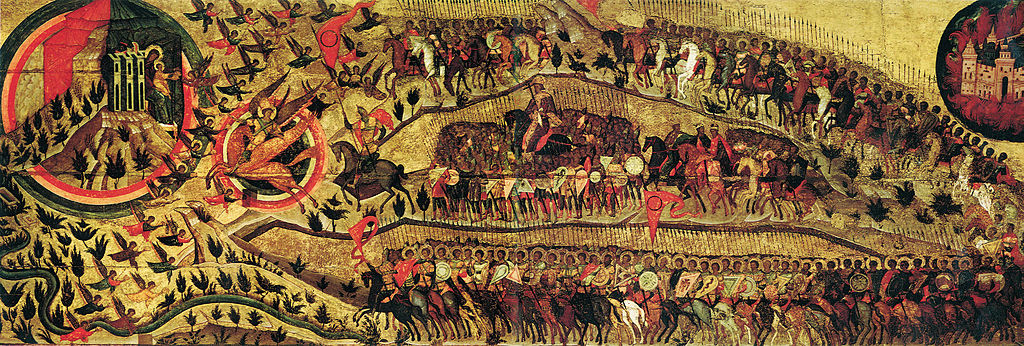
…we can understand ourselves like this:

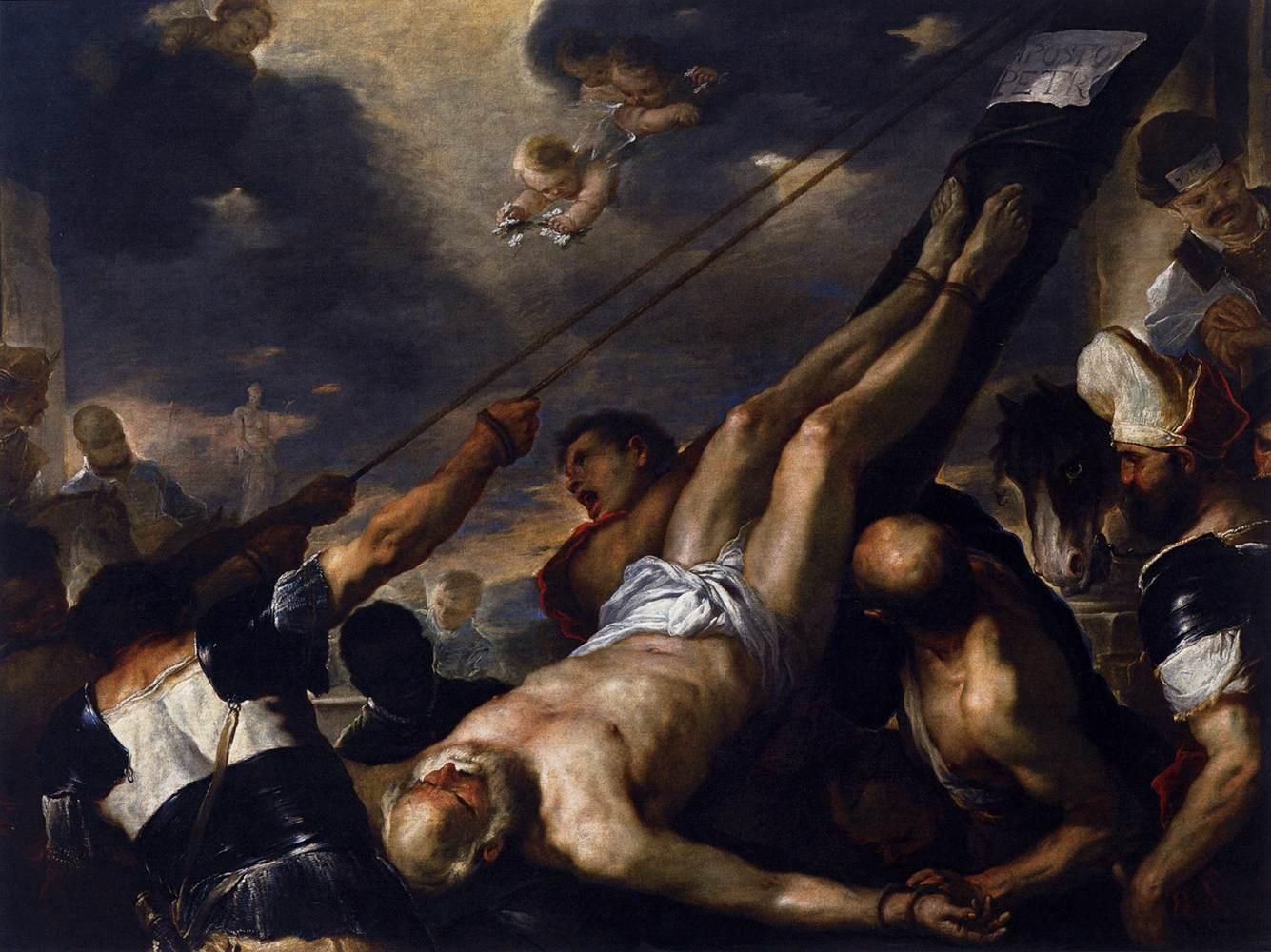
…precisely insofar as we live like this:

Few specific elements of social teaching are more basic:

43 “You have heard that it was said, ‘You shall love your neighbor and hate your enemy.’ 44 But I say to you, Love your enemies and pray for those who persecute you, 45 so that you may be sons of your Father who is in heaven; for he makes his sun rise on the evil and on the good, and sends rain on the just and on the unjust. 46 For if you love those who love you, what reward have you? Do not even the tax collectors do the same? 47 And if you salute only your brethren, what more are you doing than others? Do not even the Gentiles do the same? 48 You, therefore, must be perfect, as your heavenly Father is perfect.

(source: Matthew 5-7 RSVCE – The Beatitudes – Seeing the crowds, he – Bible Gateway)

What you’re wrong ABOUT matters, too….

Everybody wants to know what Scott Walker and Sarah Palin think about evolution, but almost nobody is asking what Nancy Pelosi and Barack Obama think about homeopathy, acupuncture, aromatherapy, and the like.

(source: Stuff and Nonsense, Gammon and Trotters! | Hang Together)

Not to re-enact Pascal’s Wager, but the more I think about this well-made point, the more I think someone should point out that–whatever their errors, and the consequences of those errors, are–people who think like this or even like this simply do not rise to the levels of repellent, foolish, monstrous lunacy we regularly find among people who think like this or this or this or this.

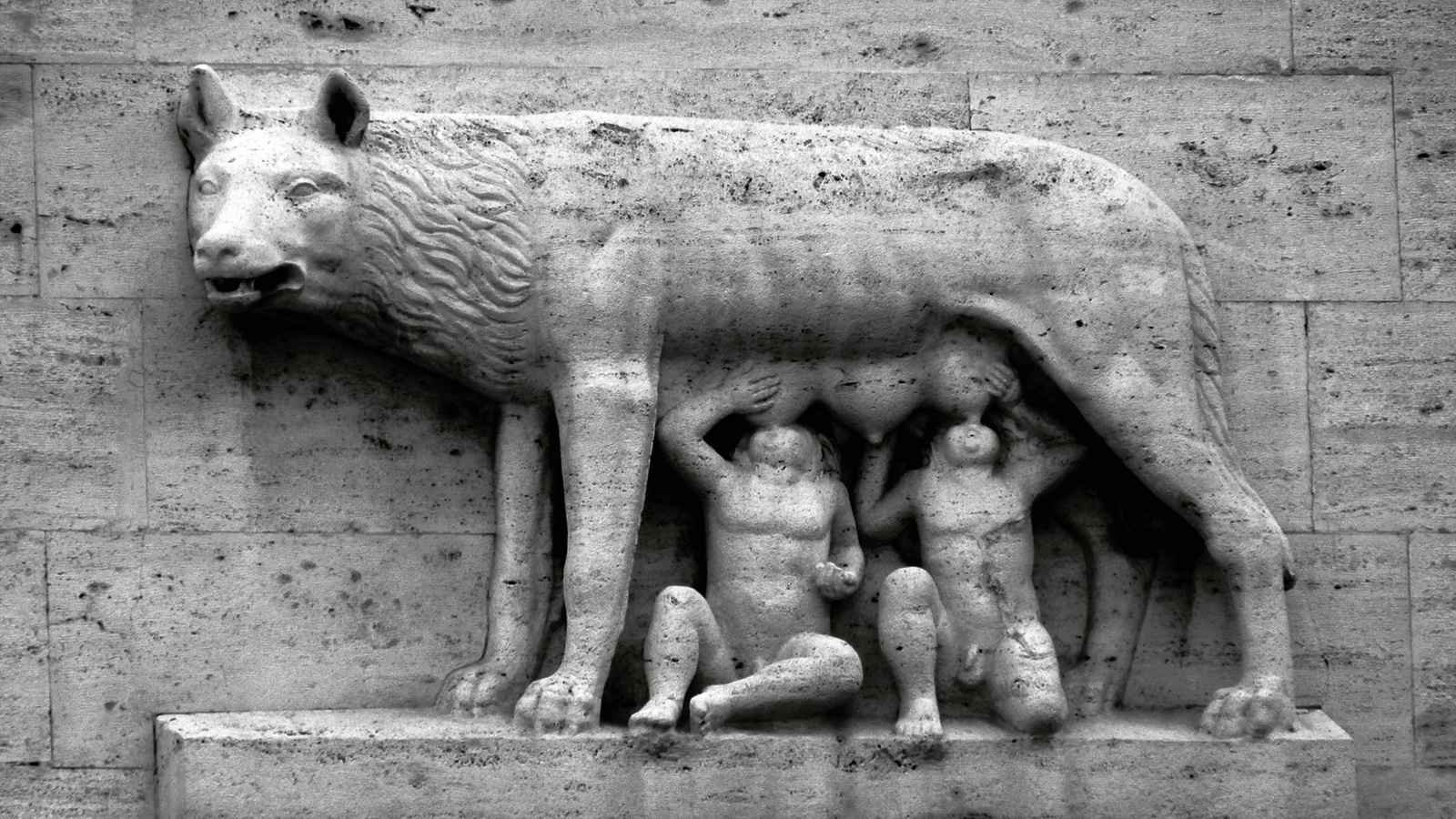
Among the pagans, attitudes like this were matter-of-fact for millennia:

Hilarion to Alis his sister, heartiest greetings, and to my dear Berous and Apollonarion. Know that we are still even now in Alexandria. Do not worry if when all the others return I remain in Alexandria. I beg and beseech of you to take care of the little child, and as soon as we receive wages I will send them to you. If-good luck to you!-you bear offspring, if it is a male, let it live; if it is a female, expose it. You told Aphrodisias, ‘Do not forget me.’ How can I forget you? I beg you therefore not to worry. The 29th year of Caesar, Pauni 23.

(source: WLGR)

While at least some Christians, and all authoritative Christian teaching, have long maintained the contrary.

Faced with a choice of mountains to climb (make no mistake you are faced with such a choice), you really must not fail to understand the religious and philosophical and historical dimensions of your choice of companions, methods, and reference points:

Father McClorey [who wrote the opposing view in the magazine] may think it better to abandon the garden to the weeds, naively confident that geniuses will make their appearances regardless of heredity and environment. But no student of genetics, no one who has even superficially observed the achievements of scientific horticulture and animal breeding, can consider seriously that the road to human perfection can ever be attained by abandoning scientific control and reverting to a childish reliance upon the blind forces of uncontrolled procreative instincts.

(source: Pelosi Getting Award Named for Woman Who Called Children ‘Human Weeds’ | CNS News)

Calling a pagan disregard for humanity “science” cannot make it so; and calling one’s religious commitment to a materialist definition of “human perfection” by “scientific control” secular does not make it rational.

And those whose religious commitment is to a self-disclosing Creator of an intelligible universe, of all people, ought to be capable of understanding what God hath wrought.

Good Mo(u)rning?

In a concession to the tearable punster in me, I offer you the following recommended greeting for those going through the text-message phase:  Are “u” in morning?

It’s so much better than “What’s good about it?”  (though not better than Gandalf’s disquistion on the goodness of mornings!)

And it might put some of us in mind of a bit of ancient wisdom with a divine stamp of approval:

It is better to go to the house of mourning
    than to go to the house of feasting;
for this is the end of all men,
    and the living will lay it to heart.

(source: Ecclesiastes 7:2-8 RSVCE)

Despite which, I do love feasting.  Fortunately, in its proper season, so does God!

The Problem of Nihilism in Public Discourse: A Case Study (Part 4)

(continued from Part 1 and Part 2 and Part 3)

Let the reader be prudent before going on. I am going to simply comment on a few passages from Bakunin that help us to see the nature of the trap, here; then I hope to move on to a few conclusions.

Jehovah, […] expressly forbade them from touching the fruit of the tree of knowledge. He wished, therefore, that man, destitute of all understanding of himself, should remain an eternal beast, ever on all-fours before the eternal God, his creator and his master. But here steps in Satan, the eternal rebel, the first freethinker and the emancipator of worlds. He makes man ashamed of his bestial ignorance and obedience; he emancipates him, stamps upon his brow the seal of liberty and humanity, in urging him to disobey and eat of the fruit of knowledge.

[…] God admitted that Satan was right; he recognized that the devil did not deceive Adam and Eve in promising them knowledge and liberty as a reward for the act of disobedience which he bad induced them to commit

(source: God and the State – Chapter I)

I cite this–the full passage is nauseating in its wrathful calumny–only to note two things. The first is the direct misrepresentation at the base of this retelling of the story: the “tree of knowledge” is not a tree of access to information, but precisely a marker of moral freedom. The misrepresentation is literal, in that “tree of knowledge of good and evil” becomes “tree of knowledge” in Bakunin’s revision.

The other–and this is crucial to grasp–is that Bakunin’s reading is not alien to the text, not a modern and secular questioning of a traditional text.  No, Bakunin is asserting that one position was always already embedded in the text, and that he and all right-thinking people have at last realized the correct perspective within the text.  That is to say, Bakunin has adopted Satan’s logic before he even introduces the name of Satan, just as the Hebrew Scriptures have always already known that God was present and active in the world, before proceeding to name Him and tell of His deeds.

Compare Bakunin’s language above with Satan’s language in the Hebrew Scriptures:  “God knows that when you eat of it your eyes will be opened, and you will be like God, knowing good and evil.”  The text presents this as a lie constructed of apparently true words, as God says, “Behold, the man has become like one of us, knowing good and evil; and now, lest he put forth his hand and take also of the tree of life, and eat, and live for ever.”  Bakunin assumes from the first the Satanic construction of this passage, that God has attempted to deprive Adam and Eve of some “knowledge” by forbidding them to eat the fruit.

It is important to realize this, because the interpenetration of secular nihilism, religious Satanism, anarchism, and other explicit philosophies of negation is easy to miss behind the camouflage Continue reading »

Point of Comparison (or, Why I Am Not A Turnip)

The act of defending any of the cardinal virtues has to-day all the exhilaration of a vice.  GKC

Note the essential similarity between the logic of Sartre (as discussed in a previous post) and the logic of Chesterton in the following two passages.

Sartre:

when we say that man is responsible for himself, we do not mean that he is responsible only for his own individuality, but that he is responsible for all men. [… I]n choosing for himself he chooses for all men. For in effect, of all the actions a man may take in order to create himself as he wills to be, there is not one which is not creative, at the same time, of an image of man such as he believes he ought to be.

(source: Existentialism is a Humanism, Jean-Paul Sarte 1946)

Chesterton:

Man can be defined as an animal that makes dogmas. As he piles doctrine on doctrine and conclusion on conclusion in the formation of some tremendous scheme of philosophy and religion, he is, in the only legitimate sense of which the expression is capable, becoming more and more human. When he drops one doctrine after another in a refined scepticism, when he declines to tie himself to a system, when he says that he has outgrown definitions, when he says that he disbelieves in finality, when, in his own imagination, he sits as God, holding no form of creed but contemplating all, then he is by that very process sinking slowly backwards into the vagueness of the vagrant animals and the unconsciousness of the grass. Trees have no dogmas. Turnips are singularly broad-minded.

If then, I repeat, there is to be mental advance, it must be mental advance in the construction of a definite philosophy of life. And that philosophy of life must be right and the other philosophies wrong. Now of all, or nearly all, the able modern writers whom I have briefly studied in this book, this is especially and pleasingly true, that they do each of them have a constructive and affirmative view, and that they do take it seriously and ask us to take it seriously. There is nothing merely sceptically progressive about Mr. Rudyard Kipling. There is nothing in the least broad minded about Mr. Bernard Shaw. The paganism of Mr. Lowes Dickinson is more grave than any Christianity. Even the opportunism of Mr. H.G. Wells is more dogmatic than the idealism of anybody else. Somebody complained, I think, to Matthew Arnold that he was getting as dogmatic as Carlyle. He replied, “That may be true; but you overlook an obvious difference. I am dogmatic and right, and Carlyle is dogmatic and wrong.” The strong humour of the remark ought not to disguise from us its everlasting seriousness and common sense; no man ought to write at all, or even to speak at all, unless he thinks that he is in truth and the other man in error. In similar style, I hold that I am dogmatic and right, while Mr. Shaw is dogmatic and wrong. But my main point, at present, is to notice that the chief among these writers I have discussed do most sanely and courageously offer themselves as dogmatists, as founders of a system. It may be true that the thing in Mr. Shaw most interesting to me, is the fact that Mr. Shaw is wrong. But it is equally true that the thing in Mr. Shaw most interesting to himself, is the fact that Mr. Shaw is right. Mr. Shaw may have none with him but himself; but it is not for himself he cares. It is for the vast and universal church, of which he is the only member.

(source: Heretics – Christian Classics Ethereal Library)

I suggest that it is worth meditating on how such a similarity comes to be.

A Pause for Thanks

Manuscript of Handel's Messiah

As some readers will doubtless know, the last week has been eventful in the Oklahoma City area.  Not, I urge, eventful in the same register as Ferguson, Missouri, or the ever-churning region from the border of Egypt to the edges of Turkey and the foothills of the Hindu Kush range.  In a manner not one whit less real, though, there has been an important conflict playing out.

I will continue my Nihilism case study series (Part 1, Part 2, Part 3), which I think was made exigent by these circumstances, and in that I will explain the responses I could see as justified, and why, including the genius of this legal response.

For now, though, I want to provide some links to give fuller understanding and background information to those who may be interested.  I am, of course, a committed partisan in this matter–but I hope that all people of good will can see something of interest and of use in this confrontation with reality.

Let there be peace.  Let us make peace.  Let us understand what makes peace possible.

All in all, a most instructive episode.  Thanks be to God that the worst seems to have been averted!  And let us be concerned that it can so easily come to this, these days.

Luminous Matter

My last night in Tripoli, I had my first Internet connection in 44 days and was able to listen to a speech Tom Durkin gave for me at the Marquette vigil. To a church full of friends, alums, priests, students and faculty, I watched the best speech a brother could give for another. It felt like a best man speech and a eulogy in one. It showed tremendous heart and was just a glimpse of the efforts and prayers people were pouring forth. If nothing else, prayer was the glue that enabled my freedom, an inner freedom first and later the miracle of being released during a war in which the regime had no real incentive to free us. It didn’t make sense, but faith did.

(source: Phone call home | Features| Marquette Magazine)

Requiem aeternamin hora mortis nostraeAll of us.

“I wish I had more time. I wish I could have the hope for freedom to see my family once again,” he can be heard saying in the video.

(source: ISIS beheading U.S. journalist James Foley, posts video – CNN.com)

Obama was briefed about the video, and “he will continue to receive regular updates,” White House spokesman Eric Schultz said.

(source: ISIS beheading U.S. journalist James Foley, posts video – CNN.com)

“James was an innocent civilian who was bravely performing his job as a journalist,” Ayotte said. “This barbaric and heinous act shocks the conscience and highlights the truly evil nature of the terrorists we confront, who must be defeated.”

(source: ISIS beheading U.S. journalist James Foley, posts video – CNN.com)

Compare and note well:

I applaud for the Academy for wanting to honor the life and work of Robin Williams. By all accounts, this comedic genius was also an incredibly gentle and giving soul, and will be missed immensely.

But consciously or not, that image of a freed Genie calls to mind these pessimistic and ultimately dangerous conclusions – not only that suicide can be a valid escape, but that the world itself may be an invalid snare.

(source: Gnostics in the Bottle | Word On Fire)

The difference is clear.

Reasonable People Stand Up When Irrational Evil Acts Out

The general indifference to ISIS, with its mass executions of Christians and its deadly preoccupation with Israel, isn’t just wrong; it’s obscene.

(source: Who Will Stand Up for the Christians? – NYTimes.com)

Good people must join together and stop this revolting wave of violence. It’s not as if we are powerless. I write this as a citizen of the strongest military power on earth. I write this as a Jewish leader who cares about my Christian brothers and sisters.

(source: Who Will Stand Up for the Christians? – NYTimes.com)

Thank you.

(what’s on your agenda, folks?)

The Problem of Nihilism in Public Discourse: A Case Study (Part 3)

You have the words of life.

(continued from Part 1 and Part 2)

Bakunin’s most notable freethought essay is “God and the State” (1883). In it, Bakunin called Jehovah, of all gods, “certainly the most jealous, the most vain, the most ferocious, the most unjust, the most bloodthirsty, the most despotic, and the most hostile to human dignity and liberty.” In this article, later published in English by Emma Goldman’s Mother Earth Publishing (1916), Bakunin wrote: “All religions, with their gods, their demigods, and their prophets, their messiahs and their saints, were created by the credulous fancy of men who had not attained the full development and full possession of their faculties.” Bakunin called the concept of Satan “the eternal rebel, the first freethinker and the emancipator of worlds.”

(source: Mikhail Bakunin – Freedom From Religion Foundation)

Neutral Is Not A Thing

defenda nos in praeloWhen spiritually and metaphysically real conflict erupts in our community, many people persuade themselves that they can retreat into their private lives, distinguish their profession from their person, and appeal to only secular standards in public discourse. Provided that they don’t see any violence that affects them, many people–public officials especially–consider the situation on par with a dispute over the bar tab or an academic debate.

And, of course, when specific criminal acts–or conspiracies to commit criminal acts–or collusion with terrorism or espionage or racketeering–when something that registers with us as a breach of the peace or an actionable injury emerges, it is perfectly natural for us to see that situation as more immediate and urgent. Were I in Ferguson, Missouri, right now, I would likely not be writing this.

But failing to take the measure of a threat because it does not seem immediate does not protect us. Believing that Islamic terrorism was a fading problem did not protect the Twin Towers in 2001 or the Benghazi consulate in 2008; knowing that Titanic‘s compartmentalized hull made her harder to sink did not protect her officers from bad judgment about speed and icebergs. Moreover, in many cases, the threat is designed to set a trap for us.

[Take, for example, policies requiring “non-discrimination” in membership and leadership of student organizations. Such policies do not allow any group to thrive or fail based on its own organizing principles and their capacity to attract at least some number of people to make common cause on those principles, whatever their other differences may be. No, such policies ensure that a group’s very survival is wholly dependent on its most aggressive opponent’s whim. The second someone determined to eradicate any group’s principles can force the choice between abandoning those principles (and continuing to exist as a group) and disbanding the group (and continuing to hold those principles in isolation), the integrity of all groups and the legitimacy of the system that encourages or subsidizes their existence is seriously undermined. At this point, the conscientious participant in public discourse is placed in a dilemma that leaves no principled option except defiance or defeat. To make it worse, the exemption of certain egregiously arbitrary and exclusive groups makes it quite clear that many administrators are not compelled to adopt these policies, nor eager to ameliorate their impact.]

The case of nihilism is both more and less subtle than such blatant yet banal acts. Continue reading »

The Problem of Nihilism in Public Discourse: A Case Study (Part 2)

Continued from Part 1.

Syme sprang to his feet, shaking from head to foot.

“I see everything,” he cried, “everything that there is. Why does each thing on the earth war against each other thing? Why does each small thing in the world have to fight against the world itself? Why does a fly have to fight the whole universe? Why does a dandelion have to fight the whole universe? For the same reason that I had to be alone in the dreadful Council of the Days. So that each thing that obeys law may have the glory and isolation of the anarchist. So that each man fighting for order may be as brave and good a man as the dynamiter. So that the real lie of Satan may be flung back in the face of this blasphemer, so that by tears and torture we may earn the right to say to this man, ‘You lie!’ No agonies can be too great to buy the right to say to this accuser, ‘We also have suffered.’

“It is not true that we have never been broken. We have been broken upon the wheel. It is not true that we have never descended from these thrones. We have descended into hell. We were complaining of unforgettable miseries even at the very moment when this man entered insolently to accuse us of happiness. I repel the slander; we have not been happy. I can answer for every one of the great guards of Law whom he has accused. At least—”

He had turned his eyes so as to see suddenly the great face of Sunday, which wore a strange smile.

“Have you,” he cried in a dreadful voice, “have you ever suffered?”

As he gazed, the great face grew to an awful size, grew larger than the colossal mask of Memnon, which had made him scream as a child. It grew larger and larger, filling the whole sky; then everything went black. Only in the blackness before it entirely destroyed his brain he seemed to hear a distant voice saying a commonplace text that he had heard somewhere, “Can ye drink of the cup that I drink of?”

(source: The Man Who Was Thursday, by G. K. Chesterton)

You Become What You Assent To

Nihilism is the belief that all values are baseless and that nothing can be known or communicated. It is often associated with extreme pessimism and a radical skepticism that condemns existence. A true nihilist would believe in nothing, have no loyalties, and no purpose other than, perhaps, an impulse to destroy.

(source: Nihilism [Internet Encyclopedia of Philosophy])

Of course, I had to cut my letter about the planned sacrilege at the Oklahoma City Civic Center to the bone to get it under the Letters to the Editor word count (any shorter and you’d have to chirp, er, whistle, er, tweet it). The original version, still only about 400 words, had a slightly clearer explanation of my objection to civic facilitation of this particular class of sacrilegious acts. In addition to the obvious spiritual consequences, there were important civic considerations that should concern even those who are not yet persuaded of the religious facts in the matter:

We understand, as all civic-minded people should, that public life involves a give-and-take of constructive and corrective expressions. This act, however, is an act of sheer nihilism, at best, and demonism, at worst.

Whether you believe it or deny it, there really are powers of good and evil that go far beyond human imagination and will. Even those who do not accept this reality, however, live in a world whose understanding of good and evil is wholly conditioned on this understanding. Civil society can profit by lively debate among different ways of accounting for these basic understandings; as an English professor, this lively exchange is precisely what I promote in the classroom daily. Civil society cannot, however, thrive in an environment where mere destruction of meaningful distinctions and cultural institutions becomes mainstream.

Nihilistic outbursts and sacrilegious demonstrations are not part of civic discussion; they are an assault on the very possibility of civil society. They intend to exclude the faithful from public life without offering any social benefit in return.

If this event takes place, it will mar this wonderful city; and it will damage the souls of all who facilitate it.

To understand the difference between the “sheer nihilism” which is, in the best case, what civic officials are facilitating here and the general give-and-take of culture-making social behavior and discourse, we will first need to understand nihilism a bit better.

Continue reading »

The Problem of Nihilism in Public Discourse: A Case Study (Part 1)

I am quite glad to see that libertarian law professor and uber-blogger Eugene Volokh has weighed in on the discussion surrounding the scheduled Black Mass in Oklahoma City.

I am glad Volokh weighed in because I know his history of carefully considering the legal principles surrounding First Amendment issues–and because I think, at least up until The Volokh Conspiracy moved to the Washington Post website and became harder to follow, I had read pretty much every post he’d written on any related subject since about 2003. I am also pleased because I think that, as regards only the specific point of legal understanding he comments on, he is probably correct.  That correction will help us all to clarify the situation considerably.

In fact, when I wrote my letter, I imagined Volokh and his confreres in order to test my words–not because I expected Volokh to be wholly sympathetic to Archbishop Coakley’s objections, but because I was confident that Volokh’s response would be accurate, to-the-point, and respectful.  Here is his post, shortening his extract from the Archbishop’s remarks:

“I’m disappointed by their response,” Archbishop Paul Coakley of the Archdiocese of Oklahoma City told FoxNews.com Friday. “If someone had come to them to rent the Civic Center to stage a burning of the Koran or to hold an event that was blatantly and clearly anti-Semitic, I think they might find a way to prevent it.

“Not all speech is protected if there is hate speech and it is intended to ridicule another religion,” he said. “I don’t believe it is a free speech matter.”

No, speech intended to ridicule or insult another religion is entirely constitutionally protected, as the Court has held since 1940. Under the First Amendment, people are free to criticize, ridicule, parody, and insult religious belief systems, no less than other belief systems — whether they are Catholicism, Islam, Judaism, Satanism, atheism, capitalism, Communism, feminism, or fascism.

And this remains true even as to government-owned auditoriums that have been generally open for public rental. The government may not exclude speech from such places, whether they are called “designated public fora” or “limited public fora,” on the grounds that it’s blasphemous or “hateful” or “intended to ridicule another religion.” (It’s an open question whether the government may sometimes exclude all religious worship services from particular kinds of government property, but I’m unaware of any such across-the-board exclusion as to the Civic Center Music Hall, and indeed at least one church apparently regularly conducts services there.)

(source: The Volokh Conspiracy) Continue reading »

The Arrow of Allegory: final causes and deflationary readings

Certain teachers and homilists consistently rub me the wrong way, reading Biblical texts in ways that seem to mean less after their explications than before.

Maybe you know the kind I mean. They teach about the Resurrection, and they do so with utter conviction that Jesus Christ really did rise from the dead. But somehow it all turns out to “really be about” how believing in the Resurrection helps us to help each other and be open to new ideas.

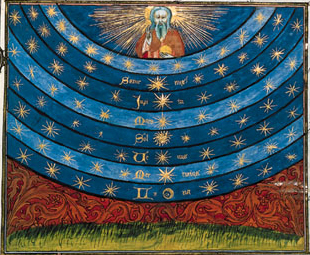
the Gnostic Ogdoad, a manifestation of dualism--the only way from God to humans is through concepts untainted by material embodiment

the Gnostic Ogdoad, a manifestation of dualism–the only way from God to humans is through concepts untainted by material embodiment

And, if you’re listening often enough, you notice that the same conclusion follows from every passage. Sometimes it corrects a misapprehension: the account of the rich man and Lazarus really should be read more emphatically in terms of the identity of the rich man’s failure of charity (in ignoring Lazarus) with his failure of faith (along with his unbelieving brothers) and his lack of well-founded hope (“in hell he lifted up his eyes”). The tendency I grew up with, of looking at this account primarily as an exposition of the nature of Hell, was arguably less helpful.

Nonetheless, the parable of the Pearl of Great Price should surely not be read so that our joy in finding the Gospel is merely or most emphatically an example of our joy in finding any of the gifts God gives us, though certainly every gift of Creation is finds its ultimate goodness united to the Gospel purpose of the Creator who calls us together in one Body with His Son. Continue reading »

Advent must be penitential

If for no other reason, then consider this:  for more of us than you think, the difference between joy–real joy, what Lewis calls “the desire to continue” and what moved Henry van Dyke to call Christ “Wellspring of the joy of living, / Ocean’s depth of happy rest”–and an oppressive, cloying, constantly faked happy-clappy-ness can only be felt in the self-exhaustion of penance.  Taxed to “rejoice” in unbroken happiness, we stumble near despair.  This world is simply not good enough to make us that happy, and to constantly pretend that God is immanently or imminently translating us into the Eschaton means to constantly cycle between delusion and disillusionment. Those who God has graced with the privilege or the ability to routinely experience happiness, we cheer on with bewildered eyes–but more often we notice the false consciousness, the doubtful props, the denials and evasions, by which many adequate their experience to their emotional needs.  Give us, though, a season for exhausting ourselves–for watching our own separation from facile happy-making grow, for becoming hungry for the simple graces and mundane joys, for insisting that these come with Jesus, with the sacraments and the blessing of the Church, or not at all–and we despair of our manufactured wish-fulfillment fantasies, and hope in Him; we are worn out with struggle, and find rest; famished, we feast.

a Spurgeon whopper

I have known a few people who regard C. H. Spurgeon as the authoritative commentator on Holy Writ; and I have heard this passage cited in sermons and seen it on blogs.  What amuses me is how few of those who retail this third-rate balderdash have apparently bothered to think about the one verifiable Bible-based criticism buried in the cant and rant:

When a fellow comes forward in all sorts of curious garments and says he is a priest, the poorest child of God may say, “Stand away and don’t interfere with my office—I am a priest—I know not what you may be. You surely must be a priest of Baal, for the only mention of the word vestments in Scripture is in connection with the temple of Baal.”

The priesthood belongs to all the saints! They sometimes call you laity, but the Holy Spirit says of all the saints, “You are God’s cleros”—you are God’s clergy. Every child of God is a clergyman or a clergywoman. There are no priestly distinctions known in Scripture. Away with them! Away with them forever! The Prayer Book says, “Then shall the priest say.” What a pity that word was ever left there. The very word, “priest,” has such a smell of the sulfur of Rome about it, that so long as it remains, the Church of England will give forth an ill savor.

“the only mention of the word vestments in Scripture is in connection with the temple of Baal” — well, OK, let’s give due credit where credit is due.  For some reason (I’m sure we can inquire about the politics of it when we reconvene the board of translators who served the successor to Elizabeth, Mary, Edward VI, and Henry VIII), the King James Version does in fact render the word “vestment” in Jehu’s flamboyant day of visitation in 2 Kings while rendering “holy garments” in God’s verbatim instructions to Moses to make vestments for the Israelite priesthood.  Now, perhaps Mr. Spurgeon would like us to abandon the term “vestment” and speak instead of “holy garments” or “sacred garments”?  Continue reading »